Here is the direct answer: to rank in Google’s AI Overviews, you need content that directly answers specific questions, demonstrates genuine expertise, earns trust through credible sources, and is structured so Google can parse and extract information quickly. There is no single trick. It is the combination of strong AI Overviews SEO fundamentals applied consistently across your site.
Google’s AI Overviews now appear at the very top of search results for a significant portion of queries globally, including in the UAE and GCC markets. They sit above every organic result, every ad, and every featured snippet. If your brand is not being cited inside those generated answers, you are losing visibility to competitors who are.
This guide covers exactly what Google looks for, how to structure your content for AI selection, and what to fix on your site starting today.
What Are Google AI Overviews and Why Do They Matter for SEO
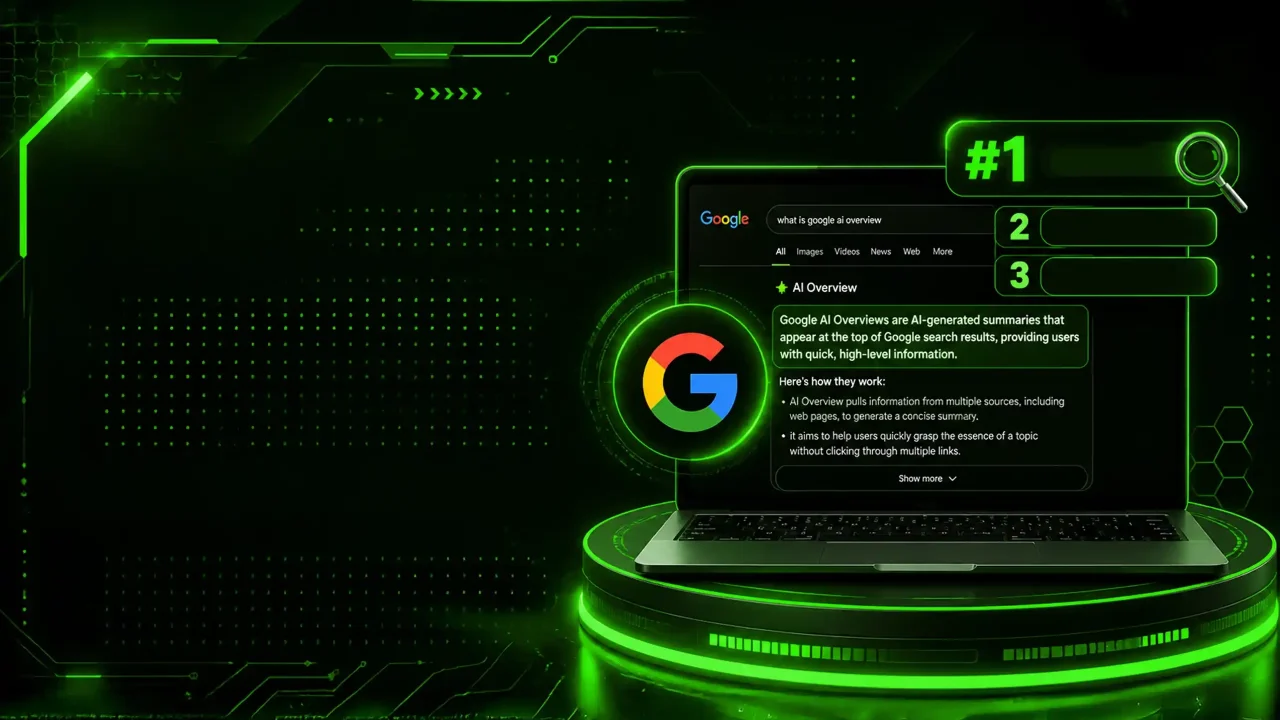
Google AI Overviews are AI-generated summaries that appear at the top of search results pages. They pull information from multiple sources across the web, synthesise it into a direct answer, and sometimes show the sources they referenced as clickable links.
They were formerly known as Search Generative Experience (SGE) during Google’s testing phase. In May 2024, Google rolled them out broadly across the United States and then expanded to additional markets including the UK, India, and parts of the Middle East.
For SEO professionals and business owners, AI Overviews represent a fundamental shift in how organic visibility works. A page that ranks in position five organically can get cited in an AI Overview and receive far more brand exposure than the page sitting in position one. The reverse is equally true. A page that ranks well but is not structured for AI citation may effectively become invisible to users who get their answer from the overview without scrolling down.
The businesses getting cited are not necessarily the biggest or most authoritative overall. They are the ones whose content best matches what the AI is trying to deliver: a clear, accurate, trustworthy answer.
How Google Decides Which Sources to Cite in AI Overviews
Understanding the selection criteria is the starting point for any AI Overviews SEO strategy.
Google’s AI does not simply pull from the highest-ranking pages. It evaluates content across several dimensions simultaneously:
Relevance to the specific query. The content must directly address what the user asked, not just touch on the general topic. A page about digital marketing broadly will not be cited for a specific query about PPC bidding strategies unless it has a dedicated section that answers that specific question clearly.
Clarity and structure. The AI needs to extract your answer efficiently. Content buried in long paragraphs, hidden behind vague headings, or structured in a way that makes extraction difficult gets passed over for content that is easier to process.
Credibility and E-E-A-T signals. Google’s framework of Experience, Expertise, Authoritativeness, and Trustworthiness applies directly here. AI Overviews favour sources that demonstrate genuine expertise, cite credible data, and have established authority in their subject area.
Freshness. For rapidly evolving topics, Google favours recently updated content. A post from 2021 about AI in marketing is unlikely to be cited when covering current AI Overview behaviour.
Corroboration. If multiple credible sources make the same claim, the AI is more confident including it. Content that makes isolated claims without supporting evidence carries less weight.
AI Overviews SEO: Step-by-Step Optimisation Strategy
Lead With the Direct Answer
This is the single most impactful change most websites can make. Google’s AI is looking for content that answers the query immediately. If your article takes three paragraphs to get to the point, you lose the citation to content that leads with the answer.
Structure every piece of content using the answer-first approach:
- State the direct answer in the opening paragraph or a dedicated summary block
- Follow with supporting explanation, context, and depth
- Use clear subheadings that reflect the questions your audience is actually asking
Think about how a knowledgeable expert answers a question in person. They give you the answer first, then explain their reasoning. That is exactly how your content should read.
Match Content to Conversational Query Formats
AI Overviews are triggered heavily by conversational, question-based searches. How, what, why, when, which, and should are the keywords that most consistently trigger AI-generated answers.
Build your content strategy around these question formats. For every core topic your business covers, map out the five to ten most common questions your audience is actually asking. Use tools like Google’s People Also Ask boxes, AnswerThePublic, and Semrush’s Keyword Magic Tool to find the exact phrasing real users type.
Then write content that directly addresses each question with a clear, specific answer. A page that answers fifteen related questions comprehensively is far more likely to be cited multiple times than fifteen separate thin pages.
Optimise Your E-E-A-T Signals Across the Site
AI Overviews heavily favour sources with strong Experience, Expertise, Authoritativeness, and Trustworthiness signals. This is not a box-ticking exercise. It is a long-term investment in how Google perceives your brand as a source of reliable information.
Practical steps to strengthen E-E-A-T for AI citation:
- Add detailed author bios with real credentials, experience, and professional links to every piece of content
- Include first-hand experience in your writing. Real case examples, actual campaign data, and specific outcomes you have achieved carry significantly more weight than generic advice
- Reference and link to credible external sources including primary research, government data, and recognised industry publications
- Keep your content updated. Review high-traffic pages at least every six months and refresh statistics, examples, and recommendations
- Build your brand’s off-site reputation through consistent coverage in industry publications, backlinks from authoritative domains, and verified business listings
Our SEO services at Digital SWOT include a full E-E-A-T audit as part of every strategy engagement, because without strong credibility signals, even the best-written content struggles to earn AI citations consistently.
Use Structured Data to Help Google Understand Your Content
Schema markup does not guarantee an AI Overview citation, but it removes ambiguity about what your content is and what it contains. When Google can clearly identify that a page contains an FAQ, a how-to guide, or an expert article, it processes that content more accurately.
Priority schema types for AI Overviews SEO:
- FAQPage schema on any page with question-and-answer sections
- HowTo schema on guides and step-by-step content
- Article schema with author and publication date on all blog posts
- Organisation schema on your homepage and about page to establish brand identity
- BreadcrumbList schema to help Google understand your site structure
Implement these through your CMS plugin, Google Tag Manager, or directly in your page source. Always validate with Google’s Rich Results Test before publishing.
Build Comprehensive Topic Clusters
Isolated blog posts rarely earn AI citations consistently. What does earn consistent citations is a website that covers a topic with genuine depth across multiple interlinked pieces of content.
The topic cluster model works as follows. You create one strong pillar page that covers a subject comprehensively. Around it, you build a series of supporting articles that each dive deep into specific subtopics. All of these pages link to each other in a logical, relevant way.
For a digital marketing agency like Digital SWOT, this means building a cluster around SEO that includes pillar content on SEO strategy, supported by detailed posts on keyword research, technical SEO, link building, local SEO, and AI Overviews SEO specifically. Each piece reinforces the others and signals to Google that this site is a genuine authority on the subject.
Improve Page Speed and Technical SEO Foundations
Google cannot cite content it cannot crawl and index efficiently. Technical issues that slow down crawling, prevent indexing, or cause rendering problems directly reduce your chances of appearing in AI Overviews.
Technical checks that directly impact AI citation eligibility:
- Core Web Vitals scores in Google Search Console, particularly Largest Contentful Paint
- Mobile usability across all key pages
- Crawl errors and blocked resources in your robots.txt
- Duplicate content issues that confuse Google about which version of a page to use
- Internal linking structure that helps Google navigate your site logically
A site that loads fast, crawls cleanly, and has a clear information architecture gives your content the best possible foundation for AI selection. Our web design and development team builds sites with these technical foundations built in from day one, not added as an afterthought.
Earn High-Quality Backlinks From Trusted Sources
Backlinks remain one of the strongest signals Google uses to evaluate source credibility. AI Overviews preferentially cite content from domains that have earned links from reputable, relevant websites.
This does not mean chasing volume. A single backlink from Gulf News, Forbes Middle East, or a recognised industry publication does more for your AI citation potential than fifty links from generic directories.
Focus your link-building efforts on:
- Guest contributions to established publications in your industry
- Original research and data that journalists and bloggers naturally reference
- Digital PR campaigns that generate news coverage and brand mentions
- Partnerships with complementary businesses that produce co-authored content
Target the Dubai and GCC Market Specifically
For businesses operating in the UAE and wider Gulf region, there is an additional layer of opportunity. AI Overviews in Arabic-language searches are still relatively underdeveloped compared to English. Creating high-quality Arabic content with strong AI Overviews SEO structure gives you a significant first-mover advantage in regional search.
English-language searches targeting Dubai and GCC-specific queries are also less competitive than equivalent global terms. A page targeting “digital marketing strategy for UAE businesses” has far fewer competing sources than one targeting the same topic globally, which means your content has a higher probability of being selected.
Our PPC and paid media and social media teams work alongside our SEO specialists to amplify content across channels, which increases the speed at which new content earns the visibility and engagement signals that support AI citation.
What Not to Do: Common AI Overviews SEO Mistakes
Publishing thin content at volume. Quantity has never been the answer in SEO and it is even less relevant for AI citations. One comprehensive, well-researched piece outperforms ten shallow articles every time.
Writing for keywords instead of questions. AI Overviews are driven by search intent, not keyword density. A page optimised around the phrase “AI Overviews SEO” but that does not actually answer the questions users are asking will not get cited regardless of its ranking position.
Ignoring content freshness. Google explicitly favours recently updated content for topics where accuracy is time-sensitive. Set a recurring review schedule for your most important pages and treat content maintenance as seriously as content creation.
Neglecting mobile experience. The majority of AI Overview impressions happen on mobile devices. Content that is difficult to read, loads slowly, or has layout issues on mobile receives lower quality signals that reduce its citation potential.
Assuming traditional ranking position equals AI citation. These are increasingly separate outcomes. A page can rank in position one and not appear in the AI Overview. A page in position eight can be cited consistently. Optimising specifically for AI citation requires a different approach to optimising purely for traditional ranking.
Frequently Asked Questions
What is AI Overviews SEO? AI Overviews SEO is the practice of optimising your website content so that Google’s AI-generated search summaries select and cite your content as a source. It involves structuring content to answer questions directly, building strong E-E-A-T signals, and using schema markup to help Google accurately interpret your pages.
Does traditional SEO still matter if AI Overviews are growing?
Yes. Traditional SEO remains the foundation. Strong technical health, quality backlinks, and well-structured content are prerequisites for AI citation. AI Overviews SEO builds on top of traditional SEO rather than replacing it.
Can small businesses get cited in AI Overviews?
Yes. Google’s AI selects sources based on content quality and relevance, not company size. A small business with deep expertise in a specific niche and well-structured content regularly earns AI citations against much larger competitors.
How do I know if my content is being cited in AI Overviews?
Search your target queries directly in Google and check whether your brand appears in the AI Overview. Google Search Console is also expanding its AI Overview data. Third-party tools including Semrush and Ahrefs are developing dedicated AI visibility tracking features.
How long does it take to start appearing in AI Overviews?
There is no fixed timeline. Some well-optimised content starts appearing within weeks of publication. For most websites, a consistent AI Overviews SEO strategy begins showing measurable results within three to six months.
Does publishing more frequently improve AI Overview citations?
Not directly. Frequency matters less than quality and comprehensiveness. Publishing two exceptional articles per week consistently outperforms publishing five thin ones. Focus on depth and accuracy over volume.
Build Your AI Overviews SEO Strategy With Digital SWOT
AI Overviews SEO is not a temporary trend. It is the direction search is heading, and the brands investing in the right content foundations today are the ones that will dominate AI-generated results for years ahead.
At Digital SWOT, we help businesses across Dubai and worldwide build SEO strategies designed for how search actually works in 2025 and beyond. From content architecture and E-E-A-T development to technical optimisation and content production programmes built for AI citation, we cover every layer of what it takes to get your brand selected, cited, and trusted by Google’s AI systems.
Talk to our team and let’s build an AI Overviews SEO strategy around your business, your market, and where search is heading next.